TL;DR: GPT 5.4 is a marked improvement over 5.2 but should not be your daily driver over Codex 5.3 or Opus 4.6. Yet, there are signs of clear qualitative improvements as bloat, erosion, and duplication are down. But GPT 5.4 has traded this cleaner code for worse performance at a higher cost.
Table of Contents
We previously discussed how Opus 4.6 and GPT-5.3 Codex were better than their predecessors but still produced god functions, duplication, and structural rot. OpenAI just shipped GPT-5.4. Every quality metric improves. It also fails more tests.
| Model | Pass % | Core % | LOC | +/- Lines | CC Mean | Erosion | High-CC % | Clones/1K |
|---|---|---|---|---|---|---|---|---|
| GPT-5.1 Codex | 59% | 45% | 1645 | +2311 / -338 | 7.1 | 0.69 | 73.7% | 90 |
| GPT-5.2 | 63% | 51% | 3208 | +4318 / -171 | 8.1 | 0.72 | 82.8% | 143 |
| GPT-5.2 Codex | 64% | 58% | 2314 | +2808 / -198 | 8.2 | 0.76 | 83.1% | 133 |
| GPT-5.3 Codex | 66% | 69% | 3257 | +4040 / -253 | 7.8 | 0.72 | 76.3% | 116 |
| GPT-5.4 | 63% | 64% | 3110 | +4103 / -454 | 5.1 | 0.68 | 63.1% | 86 |
Column definitions
- Erosion — complexity mass concentration (0-1). Replaces the composite erosion metric from our previous post. Higher means more god functions.
- High-CC % — percentage of total complexity mass in functions with CC > 10.
- Clones/1K — duplicate lines per 1,000 LOC.
5.4 is a clear upgrade to 5.2 but still lags behind both Opus 4.6 and 5.3 Codex on correctness. It wins every quality column — CC mean drops 34%, erosion drops, Clones/1K drops 26% — but pass rate drops 3 points and core drops 5.
The question is whether that tradeoff is a training artifact or something fundamental.
Signs of Improvement
5.4 takes less time per checkpoint than GPT 5.2 while writing more lines of code. 27% fewer input tokens. 30% faster. Cost is flat — more expensive per token, but uses fewer of them. It has a clearer plan and executes it in fewer iterations, but when the plan gets a boundary wrong, everything downstream inherits the mistake.
| Per Checkpoint | GPT-5.3 | GPT-5.4 | Delta |
|---|---|---|---|
| Steps | 81 | 45 | -44% |
| Duration (min) | 46 | 32 | -30% |
| Cost ($) | $3.14 | $3.27 | +4% |
| Input tokens | 1.46M | 1.07M | -27% |
| Output tokens | 25.3K | 23.5K | -7% |
First-checkpoint performance is within 1pp of 5.3 Codex (78.5% vs 79.7% pass, 82.5% vs 84.6% core). But early decisions compound — errors in the first checkpoint cascade through later ones. The lag behind 5.3 Codex is almost certainly training regimes. When OpenAI releases Codex 5.4, it should eclipse its predecessors.
But the improvements aren’t just efficiency. Quality has improved greatly too:
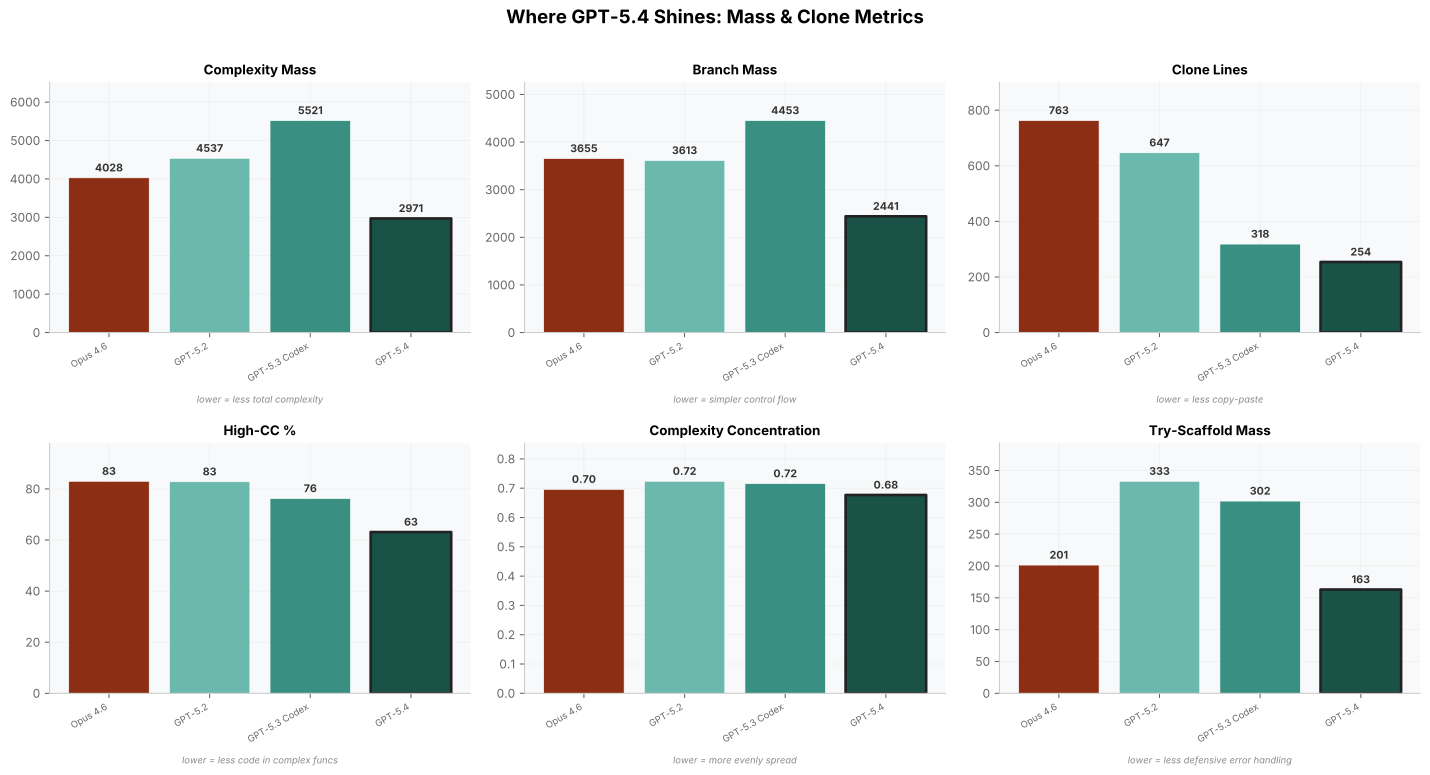
We return to my favorite example problem, code_search. There’s now tangible progress in better code organization.
Take the humble rule loading function. Codex 5.3 packs 108 lines into a single load_rules():
def load_rules(rules_path: Path) -> List[Dict[str, object]]: # ... file loading ... for idx, rule in enumerate(parsed): rule_id = rule.get("id") if not isinstance(rule_id, str) or rule_id == "": raise RulesValidationError(f"Rule at index {idx} has invalid id") # ... 40 more lines of inline field checks ... fix_config = rule.get("fix") if fix_config is not None: if not isinstance(fix_config, dict): raise RulesValidationError(f"Rule {rule_id} has invalid fix") fix_kind = fix_config.get("kind") if fix_kind != "replace": raise RulesValidationError(f"Rule {rule_id} has invalid fix kind") validated_fix = {"kind": "replace", "template": template} # ... regex compilation, pattern compilation ... validated_rules.append({"id": rule_id, "kind": kind, ...}) return validated_rulesThat makes me recoil. Antiquated type annotations. Four levels of nesting. Dict construction repeated everywhere. GPT-5.4 decomposes it:
def load_rules(rules_path: Path) -> list[Rule]: # ... file loading ... for index, item in enumerate(payload): rules.append(validate_rule(item, index, seen_ids)) return rules
def validate_rule(item: object, index: int, seen_ids: set[str]) -> Rule: # ... field validation ... fix = validate_fix(item.get("fix"), prefix) return Rule(rule_id=rule_id, kind=kind, pattern=pattern, compiled_regex=compiled_regex, fix=fix, ...)
def validate_fix(value: object, prefix: str) -> FixSpec | None: if value is None: return None # ... 10 lines of fix-specific validation ...Maybe the naming could be better. But it’s more maintainable and much cleaner to read. The decomposition also enabled a new check — 5.4 validates fix template placeholders against the rule’s metavariables. Neither 5.2 nor 5.3 does this.
Same pattern on execution_server. GPT-5.3’s _handle_execute is 164 lines with validation, caching, execution, stats, response building, all inline with raw globals and manual locks. GPT-5.4 compresses the same behavior into 49 lines with named helpers (ExecutionCache, EnvironmentExecution, STATS, validate_execute_request). That’s what erosion dropping from 0.70 to 0.51 looks like on a single problem.
GPT-5.4’s Odd Behaviors

5.4 writes more code, but it doesn’t fall into the god function trap. And the reduction in clone lines is really quite impactful. But there’s a weirdness to how it spreads out its code. Classes are up 53%, symbols up 29%.
| Metric | GPT-5.3 | GPT-5.4 | Delta |
|---|---|---|---|
| Statements per function | 9.5 | 5.7 | -40% |
| Lines per symbol | 27.4 | 19.7 | -28% |
| Try-scaffold mass | 302 | 163 | -46% |
| Max nesting depth | 5.5 | 4.9 | -11% |
| Symbols total | 172 | 221 | +29% |
| Classes | 15.8 | 24.1 | +53% |
| Methods | 34.5 | 55.9 | +62% |
| Trivial wrappers | 3.0 | 7.0 | +133% |
Top half: real improvements with Smaller functions, shallower nesting, half the try/except scaffolding.
Bottom half: higher costs, 29% more symbols in less code, classes up 53%, trivial wrappers more than double. Try-except mass down 46%, max depth down 11%. OpenAI has clearly reacted to public slop complaints by training against it. 5.4 learned “small functions good” and over-applied it — wrappers that just call another function, classes where a module-level function would do.
Type Annotation Inconsistency
The base model comes through, and there’s a terrible inconsistency with type annotations. The worst part: there is NO consistency. We checked every final snapshot across all 20 problems:
| Model | Pure Modern | Pure Legacy | Mixed | No Types |
|---|---|---|---|---|
| GPT-5.2 | 5 | 5 | 10 | 0 |
| GPT-5.2 Codex | 3 | 8 | 4 | 5 |
| GPT-5.3 Codex | 3 | 14 | 2 | 1 |
| GPT-5.4 | 11 | 2 | 7 | 0 |
5.2 was the most confused — 10/20 problems mix List[str] and list[str] in the same file. 5.3 “fixed” this by going almost entirely legacy: 14/20 pure typing.List/Dict/Optional. Consistent, just consistently old.
5.4 swings the other way — 11/20 pure modern (list[str], | None). Clear preference for the right style. But 7 problems still mix both in the same file. dynamic_config_service_api has 417 legacy annotations and 6 modern ones. database_migration is 21% modern — it shifted mid-stream but never went back. Once 5.4 picks a style for checkpoint 1, the legacy annotations persist through all later checkpoints even as new code uses modern syntax. It will never attempt to update old legacy annotations. Compared to 5.2, this is an improvement. But the inconsistency is still maddening. 5.3 is more consistent simply because it consistently picks the wrong style. So…an improvement?
Capabilities Dropped Across Generations
Returning to code_search, we see the downside to OpenAI’s iterations. 5.2 had multi-pattern support (sliding-window matching for patterns that parse to multiple AST nodes) and separator-skipping for optional metavars. 5.4 replaced inline wrapping logic with a clean PATTERN_PARSE_STRATEGIES dispatch table — but dropped both features. Each generation cleans up the structure while quietly dropping capabilities.
Conclusion
5.4 writes code you’d want to maintain, but you need to be more vigilant checking for incorrect code. SlopCodeBench shows that code correctness and quality are not on the same axis. The models are getting better at writing code that looks right. They’re not getting better at making code that is right.
We want to keep pushing these models and investigating what the future of code agents will be. The GitHub repo is open. Join us on Discord.
Methodology
All results: 20 SCBench problems, 93 checkpoints. Same “just-solve” prompt, thinking=high, Codex CLI. Pinned versions (5.1: 0.65.0, 5.2: 0.93.0, 5.3: 0.98.0, 5.4: 0.110.0). See our announcement post for scoring details.