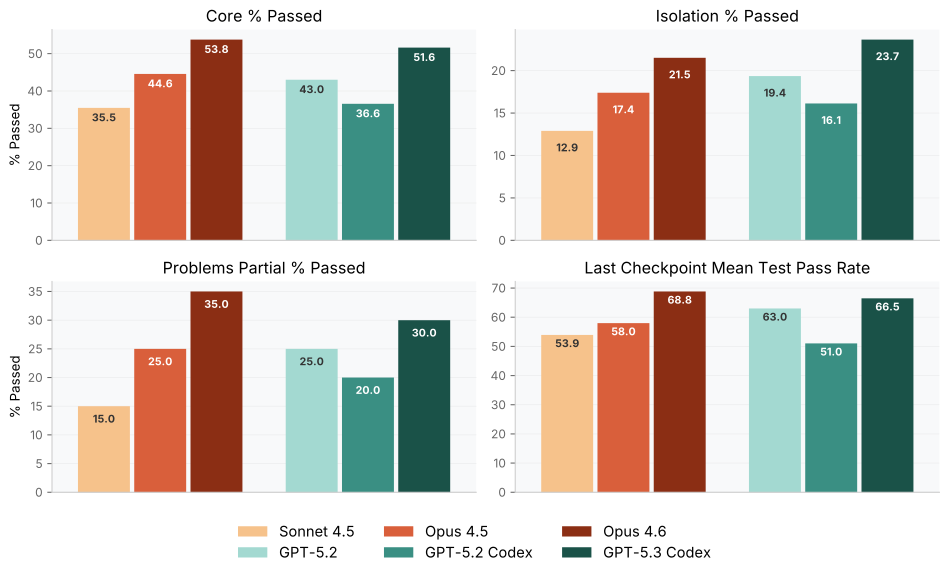
TL;DR: Opus 4.6 hits 53.8% core on SCBench but only 21.5% in isolation. GPT-5.3 Codex shows the same pattern at 51.6% core, 23.7% iso. Most ‘passing’ solutions are coupled to prior checkpoint state. They fail in opposite directions. Opus copy-pastes and sprawls. Codex over-abstracts and deepens. Both still produce god functions and structural rot. Two case studies (
circuit_evalandexecution_server) show where it goes wrong, plus a guide for when to trust, when to intervene, and when to restart.
Table of Contents
In our last post, we showed that coding agents are lazy patchers — copy-paste duplication, god functions, missed abstractions. Because both Anthropic and OpenAI dropped new models last week, we now have results for Opus 4.6 and GPT-5.3 Codex for SlopCodeBench.
| Model | Core % | Iso % | Cost/CKPT | Verbosity | Erosion |
|---|---|---|---|---|---|
| Sonnet 4.5 | 35.5% | 12.9% | $1.54 | 0.909 | 0.485 |
| Opus 4.5 | 44.6% | 17.4% | $2.64 | 0.932 | 0.490 |
| Opus 4.6 | 53.8% | 21.5% | $3.47 | 0.965 | 0.442 |
| GPT-5.2 | 43.0% | 19.4% | $4.55 | 0.765 | 0.462 |
| GPT-5.2 Codex | 36.6% | 14.0% | $3.21 | 0.723 | 0.398 |
| GPT-5.3 Codex | 51.6% | 23.7% | $3.14 | 0.844 | 0.432 |
Column definitions
- Core % — percentage of checkpoints where just the core tests pass against the agent’s cumulative solution.
- Iso % — percentage where the solution passes all checkpoint tests independently, regardless of whether it failed the prior checkpoints.
- Cost/CKPT — average USD cost per checkpoint.
- Verbosity — Ratio of AST-Grep-flagged spans plus rubric flags to logical lines of code.
- Erosion — Percentage of functions with >10 Cyclomatic Complexity + lint errors per line of code. Functions with CC>30 counted twice.
Higher scores, yes, but most checkpoints still fail when run in isolation. The misses are boundary inference, not algorithms, and when they happen matters more than how many.
The new models Head to Head
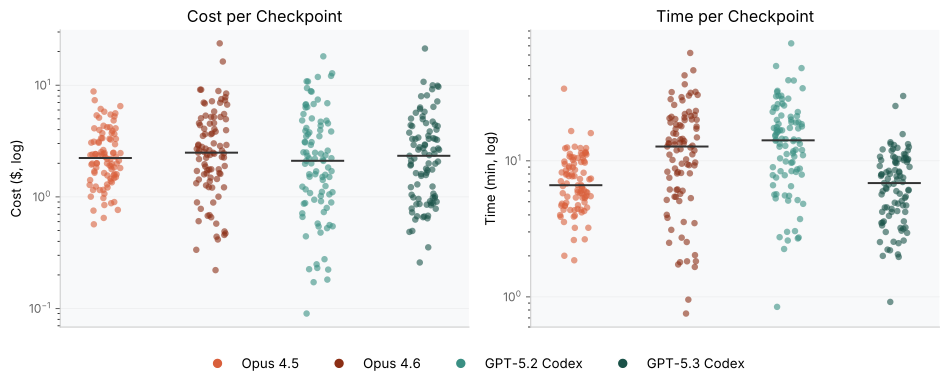
GPT-5.3 Codex is 54% faster per checkpoint than GPT-5.2 Codex (16.2 → 7.5 min mean). Opus 4.6 is nearly twice as slow as 4.5 (7.6 → 14.4 min mean). For cost, Opus 4.6 is 32% more expensive than 4.5 (3.47), while GPT-5.3 Codex is 2% cheaper than 5.2 Codex (3.14).
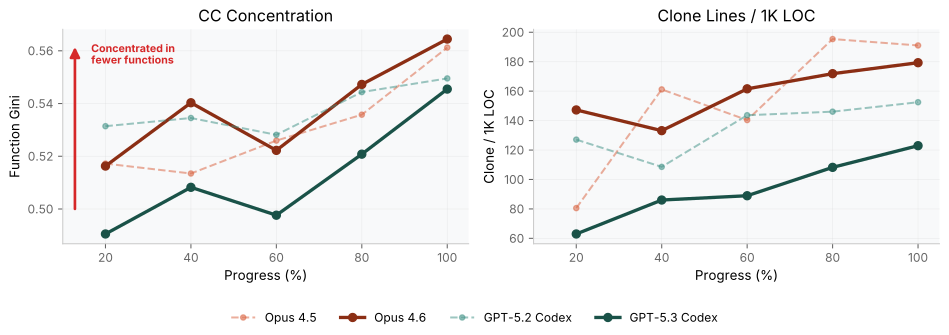
Complexity concentration differs by 0.013 at the final checkpoints. But for copy-paste hackiness, Opus 4.6 is much worse: 174 clone lines per 1K versus 116 for GPT-5.3 Codex.
The Differences Emerge At the Boundaries
The differences are at the boundaries: serialization, reporting, validation, postconditions. Once a boundary assumption lands at CKPT3 or CKPT4, every later checkpoint builds on top of it.
We covered code_search last time. This post traces two problems checkpoint by checkpoint: circuit_eval and execution_server.
Perfect through CKPT3, then boundary misses persist
Our first study is on our longest problem, circuit_eval, where the agent is tasked with implementing a CLI tool for parsing and analyzing small digital circuits. It starts as a strict parser/validator, then grows into an evaluator (2val and 3val), and ends with a deterministic optimizer + equivalence checks. This problem is mostly boundary work: literal formats, width rules, canonical output, and postconditions.
Checkpoint progression
| CKPT | Adds (high level) |
|---|---|
| 1 | CLI + check for scalar .circ parsing/validation |
| 2 | Scalar 2-valued eval |
| 3 | Vectors, slicing/concat, richer literals, and --radix |
| 4 | --mode 3val evaluation (X in runtime inputs; binary-only radix) |
| 5 | --format: add .json and .bench inputs |
| 6 | Analysis tools: stats, lint, and dot |
| 7 | cone, truth-table, and equiv (plus --seed) |
| 8 | Optimizer opt (passes, determinism, --verify, --fanin-limit) |
Progression: both models are perfect through CKPT3 (203/203). The first split is CKPT4 (Opus 428/428 vs Codex 427/428). By the end, totals are nearly tied (CKPT8: Codex 554/557 vs Opus 553/557), but core diverges the other way on opt postconditions (Codex 15/17 vs Opus 17/17).
The split starts at CKPT4 (3val mode). The first failure itself is small (an input-parsing edge case), but the more revealing artifact is how both implementations grow across checkpoints. Each new part adds a subcommand or a handful of flags, and both agents respond by attaching another branch to their CLI dispatcher.
Opus 4.6 (checkpoint 8): opt flag parsing lives inside main() and mixes parsing, defaults, and JSON error routing in one block.
elif command == 'opt': filepath = args[1] rest = args[2:] output_path = None pipeline = 'default' max_iters = 6
i = 0 while i < len(rest): a = rest[i] if a == '-o': if i + 1 >= len(rest): err = CliUsageError("-o requires a value") if use_json: output_json(make_error_response("opt", err)) else: print(f"Error: {err}", file=sys.stderr) sys.exit(EXIT_CLI_USAGE) output_path = rest[i + 1] i += 2GPT-5.3 Codex (checkpoint 8): parsing is centralized in parse_action(), which returns a structured Action that main() then executes.
if command == "opt": out_path: Optional[str] = None pipeline = "default" max_iters = 6
idx = 0 while idx < len(rest): token = rest[idx] if token in {"-o", "--output"}: if idx + 1 >= len(rest): raise CliUsageError("-o requires a path") out_path = rest[idx + 1] idx += 2 continueSame “lazy patcher” dynamic from our first post. The dispatcher is the easiest place to land changes, so it keeps growing until it is the API boundary.
A single mistake in CKPT3 creates a 7-test gap through CKPT5
We now examine execution_server: a minimal HTTP API for CI-style local execution. You send a JSON request describing a command (later: command chains), environment variables, file overlays, stdin, and timeouts; the server runs the process unsandboxed, then returns stdout/stderr, plus optional tracked output files and stats. Later checkpoints add structured file serialization, caching, and persistent environments with concurrency rules.
Checkpoint progression
| CKPT | Adds (high level) |
|---|---|
| 1 | POST /v1/execute + GET /v1/stats/execution (timeouts, stdin, env, file overlay) |
| 2 | track: glob output files and return contents |
| 3 | Structured files values + serialize by extension (json/yaml/csv/jsonl + compression) |
| 4 | Command chains + continue_on_error + per-command stats |
| 5 | In-memory cache (force bypass) + cache stats |
| 6 | Persistent environments: POST /v1/environment, concurrency modes, required environment in execute |
Progression: CKPT1-2 are tied (43/45, then 56/58 for both). CKPT3 is where the gap opens (Codex 100/103 vs Opus 93/103; core 16/16 vs 14/16), and it persists through CKPT5 (184/187 vs 177/187). CKPT6 narrows to a 1-test gap (69/70 vs 68/70), but core still differs (25/25 vs 24/25).
This problem is almost entirely request/response normalization. Each checkpoint adds more shape to the request (track, structured files, command chains, caching, environments), so the question is where to put the normalization layer. In this head-to-head, the CKPT3 gap is one strict-type gate in that layer (files scalars): Codex serializes them for .json paths, while Opus rejects them.
Opus 4.6 (checkpoint 6): validation and normalization happens inline in handle_execute(), branching early on “single command vs chain”.
command = body.get("command")if command is None: return _error_response(400, "Field 'command' is required", "MISSING_FIELD")
is_chain = isinstance(command, list)
if is_chain: if len(command) == 0: return _error_response( 400, "Field 'command' array must not be empty", "INVALID_FIELD" ) for i, cmd_obj in enumerate(command): if not isinstance(cmd_obj, dict): return _error_response( 400, f"Command at index {i} must be an object", "INVALID_FIELD", )GPT-5.3 Codex (checkpoint 6): _validate_execute_payload() normalizes inputs into one internal shape (commands list + defaults), so later checkpoints can mostly “append one more field”.
command_input = payload["command"]command_mode = "single"commands = []if isinstance(command_input, str): if not command_input.strip(): raise ValueError("INVALID_COMMAND: 'command' must be a non-empty string.") commands.append( { "cmd": command_input, "timeout": default_timeout, "required": False, } )elif isinstance(command_input, list): command_mode = "chain" if not command_input: raise ValueError("INVALID_COMMAND: 'command' array must not be empty.")else: raise ValueError( "INVALID_COMMAND: 'command' must be either a non-empty string or a non-empty array." )Once you pick one of these shapes at CKPT3-4, later parts (cache, environments, concurrency modes) are mostly additive. But one wrong type gate early on (like what counts as a valid files payload) is enough to open a gap that never closes.
How does this compare to their predecessors?
Both are better than their predecessors:
- Most gains are boundary hygiene: making the contract match the spec and making invariants explicit.
- The first divergence is early (CKPT3-4) and becomes inherited behavior across later checkpoints.
- Codex tends to encode invariants and fail fast; Opus tends to preserve behavior and “return something”. Either can win depending on which parts of the spec are actually load-bearing.
SCBench shows why these models feel “off” despite the higher scores.
Claude Code
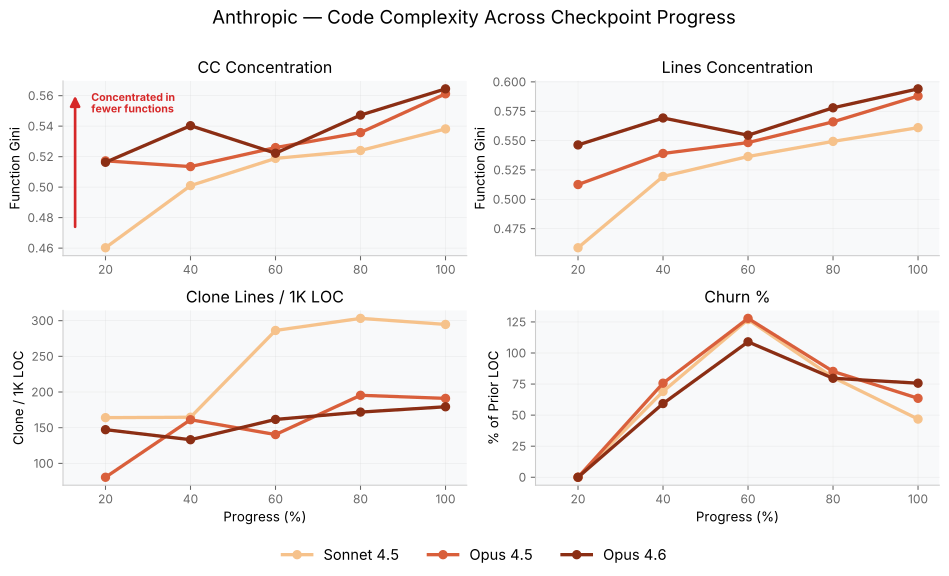
Opus 4.6 is incrementally better: 3 fewer clone lines per 1K LOC at the final checkpoint (174 vs 177). CC concentration is essentially flat (0.554 → 0.553), and both remain miles ahead of Sonnet 4.5.
God functions still grow unbounded. Opus 4.6’s main() is 1,122 lines at checkpoint 8 (lines 3923-5044). The opt subcommand parser alone is 302 lines of hand-rolled argument parsing inside main(). A lookup table would eliminate hundreds of lines. Horizontal sprawl continues with copy-paste duplication, larger files, and shallower call trees. Opus 4.6 writes four copies of Kahn’s topo sort on circuit_eval: two in the evaluators (eval_circuit and eval_circuit_3val, differing by one line), one in compute_depth, and one in a generic _topo_sort_assignments helper. The helper is the right abstraction (it gets called 9 times in the optimizer passes) but the agent never went back to wire it into the three earlier copies. Each new feature wires into the monolith instead of factoring through shared code.
Codex
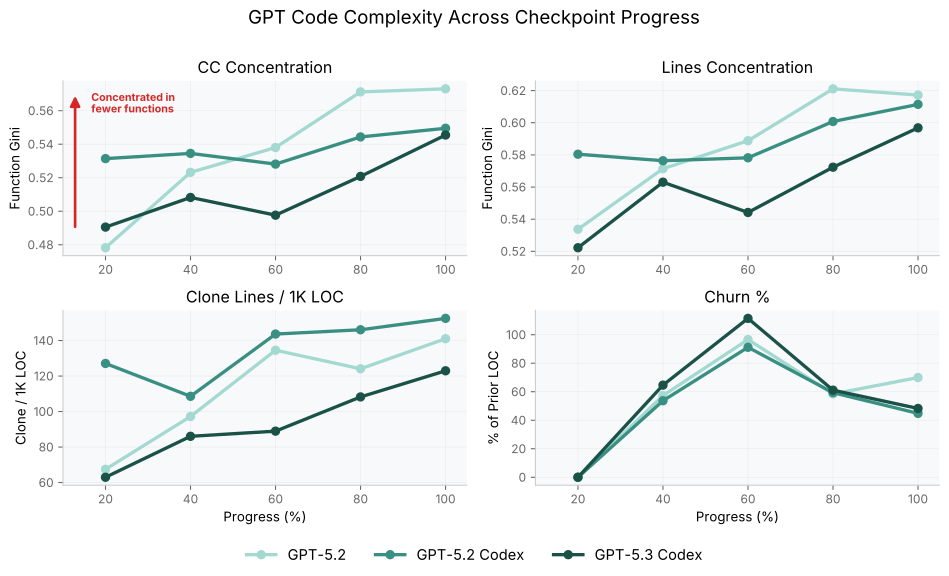
Unlike Anthropic’s offerings, GPT models have made gains in CC concentration, with a raw decrease of 0.018 at the final checkpoint from GPT-5.2 Codex to 5.3 Codex (0.557 → 0.540). This pattern repeats across the other metrics we track. OpenAI is doing something right here.
GPT models build vertically with deeper functions and more abstraction layers, but those abstractions don’t hold up. GPT-5.3 writes six near-identical validation functions (parse_cone_out_format_value, parse_truth_table_out_format_value, …) where one function with two parameters would do. Its pass_constfold and pass_algebra are identical 244-line optimization passes differing in a single boolean. parse_action is 954 lines. It doesn’t copy code between functions as much as Claude does, but it packs everything into fewer, deeper functions.
GPT-5.3 sometimes builds the right abstraction and then breaks it. At code_search checkpoint 1, it creates a unified Iterable interface for both exact and regex matchers through Iterable[Tuple[int, int, str]]. This means that the match dict is only constructed once. But then at checkpoint 3, instead of extending the interface for pattern matching, it sets iterable = None and builds a completely separate code path. The abstraction was correct and existed, but the agent broke it anyway because extending an interface is harder than duplicating the consumer.
Credit Where Due
To be clear, both models show genuine progress:
- Codex: centralized boundary validation (e.g., POCKET shape/cardinality), more consistent contract enforcement (e.g.,
404vs409choices), and better ingestion hygiene (quoting dotted logical names). - Opus: better at preserving legacy behavior under change (avoiding the strict destination gate that collapses
file_backup), and willing to take pragmatic library dependencies (wcmatch) to get broad compatibility quickly.
But they coexist with a 954-line god function, clone ratios climbing checkpoint-to-checkpoint, and regressions introduced mid-refactor. There is clearly awareness of better code design, yet these models will not do it on their own.
When to Trust the Agent
Without active supervision, these agents compound mistakes quickly enough that you can end up better off rebuilding from scratch. But the failure modes are predictable, and the data points to a practical framework for when to trust and when to intervene.
| Task Type | Trust Level | Stronger Model | What to Review |
|---|---|---|---|
| Boundary logic (parsing, validation, error codes) | Medium | GPT-5.3 Codex | Type gates, status codes, edge-case assumptions |
| Scheduling / temporal | Low | Opus 4.6 | Multi-trigger semantics, timestamp precision, window boundaries |
| Pattern matching / search | Medium | Opus 4.6 | Coordinate systems (inclusive vs exclusive), AST vs text matching |
| Optimization / transforms | Medium | Tied | Alias resolution, pass ordering, postcondition enforcement |
| Dependency management | Low-Medium | GPT-5.3 Codex | Version pinning, API compatibility across versions |
| Structural refactoring | Low | Neither | Abstraction breakage, sentinel introduction, lost invariants |
Evidence per row
- Boundary logic (Codex edge): On
execution_serverCKPT3, Codex’s centralized_validate_execute_payload()passes 100/103 vs Opus’s inline validation at 93/103. The gap is a single type gate forfilesscalar serialization. (Counterexample: onlog_queryCKPT1, Claude’s explicit keyword tokenization passes 134/134 vs Codex’s 131/134 — Codex acceptsSELECT trueas a valid field name.) - Scheduling/temporal (Opus edge): On
file_backupCKPT1, Claude’s trigger enumeration (get_trigger_times() → list) passes 28/32; Codex’s booleanjob_is_due() → boolcannot represent multiple triggers in a duration window and passes only 21/32. The 7-test gap is entirely multi-trigger and timestamp-precision failures. - Pattern matching (Opus edge): On
code_searchCKPT3, Claude’s text-segment matcher passes 40/44 vs Codex’s AST-based matcher at 36/44. By CKPT5, Claude leads 94/101 vs 88/101. Codex’s strict AST compilation rejects valid patterns; Claude’s permissive matching occasionally truncates captures but fails open rather than closed. - Optimization/transforms (Tied): On
circuit_eval, both models are near-perfect through CKPT3 (203/203). At CKPT4, Codex gets 427/428 vs Opus’s 428/428. By CKPT8, the gap flips: Codex 554/557 vs Opus 553/557. - Dependency management (limited evidence): Opus takes pragmatic library dependencies (e.g.,
wcmatchfor glob matching); Codex builds custom implementations. Neither approach resolved the 4 shared glob failures onfile_backup. This row has the weakest direct evidence across our problems. - Structural refactoring (Neither): On
file_backupCKPT3, Codex’s typedJobdataclass enforced destination validation at parse time — correct for the new checkpoint, but it broke 28 checkpoint-1/2 regression tests (18/68 total vs Claude’s 53/68). Claude preserved backward compatibility but missed the required validation entirely.
Early-Checkpoint Boundary Review
If you’re using these agents iteratively, review boundary decisions at the first 2-3 checkpoints. A wrong boundary assumption at CKPT2 costs much more than one at CKPT7, because every downstream component inherits the error. Here’s what to check:
- Where does validation live? Is it centralized in one function, or scattered across handlers? On
execution_server, Codex’s single_validate_execute_payload()was easier to extend than Opus’s inline checks spread throughhandle_execute(). - Are inputs normalized to one internal shape? Codex normalizes all
execution_servercommands into acommandslist with defaults; Opus branches on “single command vs chain” inline and carries the branch through every later checkpoint. - Do error messages match the spec? If the spec says “return 400 with MISSING_FIELD,” verify the agent does that, not a generic 500 or a silent default. On
log_query, Codex acceptedSELECT trueas a field name when the spec required an error. - Does the new checkpoint break old behavior? On
file_backupCKPT3, Codex’s strictparse_destination()was correct for the new requirement but broke 28 existing regression tests because older schedules had nodestinationfield.
Red Flags to Watch For
These are observable in code review and git diffs. You don’t need a benchmark to spot them.
- God function emergence (>200 lines). Both models exceeded 900 lines by
circuit_evalCKPT8. Detect with your linter’smax-function-lengthrule, or count lines betweendefboundaries. If a single function is growing with every iteration, the agent has stopped decomposing. - Copy-paste duplication (same block in 3+ places). Opus 4.6 writes four copies of Kahn’s topo sort on
circuit_eval— two in the evaluators (differing by oneeval_exprcall), one incompute_depth, and one in a generic_topo_sort_assignmentshelper that gets called 9 times elsewhere but never wired back into the first three. Detect withjscpd --min-lines 10 ., or search for distinctive repeated lines:rg -c 'while queue:' *.py. If the same 15-line block appears three times, the agent is copying rather than abstracting. - Sentinel values bypassing an interface. GPT-5.3 sets
iterable = Noneincode_searchto skip its own unified iterable interface. In review, look forOptionaladditions oris Nonechecks that didn’t exist in the prior diff. They often signal a dead abstraction the agent is working around rather than extending. - Churn without progress. Compare
git diff --statbetween iterations. High add and remove counts with no new passing tests means the agent is rewriting rather than extending.
When to Restart vs Repair
execution_server CKPT3 is the clearest example. Opus rejects scalar files values for .json paths where Codex serializes them. That one type gate opens a 7-test gap (93/103 vs 100/103) that persists through CKPT5 (177/187 vs 184/187). Every later checkpoint (chains, caching, environments) inherits the wrong assumption. By CKPT5, the fix means unwinding three checkpoints of validation logic built on top of the original gate. Restarting from CKPT2 is cheaper.
Rules of thumb:
- If a structural change breaks >50% of existing tests, the agent has changed the contract, not extended it. Revert and re-prompt with explicit backward-compatibility constraints.
- If the same boundary assumption has been wrong for 3+ checkpoints, repair costs compound. Each checkpoint builds on the prior, so a wrong type gate at CKPT2 means unwinding through every subsequent checkpoint. Restart from the last clean checkpoint.
- If the agent introduces a sentinel to bypass its own abstraction, the abstraction is dead. Extending it further just adds more sentinels. Strip the abstraction and rebuild with a concrete implementation.
Conclusion
Opus 4.6 and GPT-5.3 Codex are genuinely better than their predecessors on SCBench. Head-to-head, they mostly trade wins based on boundary decisions.
But the structural rot persists, as god functions continue to grow unbounded and duplication continues to climb with every iteration. Abstractions are built and then broken. The gap between “passes tests” and “maintainable software” is one of the most important questions we should be investigating right now. And that is why we built SCBench. The GitHub repo is open, and the benchmarks are reproducible. If you want to dig deeper or challenge these findings, join us on Discord.
Methodology
All results are based on 20 SCBench problems across 93 checkpoints. Every model runs the same “just-solve” system prompt with thinking set to high. Claude models (Sonnet 4.5, Opus 4.5, Opus 4.6) run through Claude Code; GPT models (GPT-5.2, GPT-5.2 Codex, GPT-5.3 Codex) through the Codex CLI. We used pinned harness versions to ensure reproducibility. For full details on problem structure and scoring, see our announcement post.